Blog

  • Cold Email Deliverability in 2026: The Complete Guide for Cold & Non Opt-In Senders


    Almost every deliverability guide you’ll find online was written for the wrong sender.

    They were written for opt-in marketers, people emailing a list of subscribers who asked to hear from them, opened the last newsletter, and clicked a link or two. That sender starts every campaign with a tailwind of positive engagement. Their advice (“send great content, segment your list, watch your open rates”) works because their recipients already wanted the email.

    Cold email is a different sport. Your recipients didn’t ask for your message. There’s no prior engagement for the mailbox provider to lean on. And the moment you send at any real volume, you trip the exact tripwires that get accounts suspended on Mailchimp, SendGrid, and Constant Contact. You’re playing the deliverability game on hard mode, against the same Gmail and Outlook filters but without the safety net.

    This guide is the cold sender’s playbook. It covers everything that actually moves the needle when you’re sending to prospects who’ve never heard of you: authentication, domain architecture, warmup, list hygiene, content, monitoring, and the compliance lines you can’t cross. Where the rules are different for cold senders — and they often are — we’ll say so directly.

    Key takeaways

    • Deliverability (landing in the inbox) is not the same as delivery (not bouncing). You can have a 98% delivery rate and a 20% inbox rate at the same time.
    • In 2026, authentication is the price of admission, not a competitive edge. SPF, DKIM, and DMARC are mandatory — Gmail, Yahoo, and Microsoft now reject mail that fails them.
    • For cold senders, list quality is the single highest-leverage variable. A clean, well-targeted list beats every clever tactic.
    • Never send cold email from your primary business domain. Use separate, authenticated sending domains you can afford to burn.
    • Engagement is the modern reputation currency. Replies are worth more than opens; complaints can sink you in days.

    Delivery vs. Deliverability: The Distinction That Quietly Kills Cold Campaigns

    Most senders track the wrong number.

    Delivery rate is the percentage of your emails that weren’t rejected outright by the receiving server. If 98 of every 100 messages were accepted, your delivery rate is 98%. Your ESP dashboard shows this number proudly, and it tells you almost nothing about whether anyone saw your email.

    Deliverability — also called inbox placement — is the percentage of accepted emails that landed in the primary inbox, rather than the spam folder, the Promotions tab, or some quiet quarantine the recipient never checks.

    These two numbers can diverge wildly. A campaign can post a 98% delivery rate and a 20% inbox-placement rate simultaneously: nearly every message was accepted, and four out of five still went to spam. The sender sees “98% delivered,” assumes the campaign worked, and never learns why the replies didn’t come.

    For cold senders this gap is the whole ballgame. Your delivery rate will usually look fine. Inbox placement is where cold campaigns live or die, and it’s the only metric this guide is built to improve.

    Why Cold Email Is a Harder Deliverability Problem

    Before the tactics, it’s worth understanding why cold senders face a steeper climb. Three structural disadvantages stack against you.

    1. You start with zero engagement history. Modern filters at Gmail and Outlook are overwhelmingly engagement-driven. They watch whether recipients open, reply, archive, ignore, or report your mail, and they score your domain accordingly. An opt-in marketer’s list is full of people who engage. Your cold list is full of strangers, so you have no positive signal to draw on and the filter’s default posture toward an unknown sender is skepticism.

    2. Your lists are inherently riskier. Cold lists are scraped, bought, or built from public sources. That means a higher baseline rate of dead addresses, role accounts, catch-alls, and — most dangerous of all — spam traps. Every one of those degrades your reputation faster than anything an opt-in sender will ever encounter.

    3. Mainstream platforms are built to stop you. This is the one most people learn the hard way. Mailchimp, Constant Contact, SendGrid, Brevo, and Mailgun all prohibit cold or non-opt-in sending in their terms of service, and they enforce it aggressively. The reason is structural: those platforms run their customers on shared IP pools, so every sender’s reputation is everyone’s reputation. One cold sender generating complaints can damage inbox placement for thousands of other customers on the same IPs. The platform’s only rational defense is to detect cold sending and suspend the account — often without warning and without a refund.

    This is why purpose-built cold email infrastructure exists. A platform like BulkResponse is architected around the assumption that you’ll send to cold, non-opt-in lists — so legitimate cold outreach doesn’t trigger a ban. But “won’t get you banned” is not the same as “will land in the inbox.” No platform can authenticate your domain, warm it up, or clean your list for you. The rest of this guide is the work that’s on you.

    The 2026 Inbox Rulebook: What Gmail, Yahoo & Microsoft Now Require

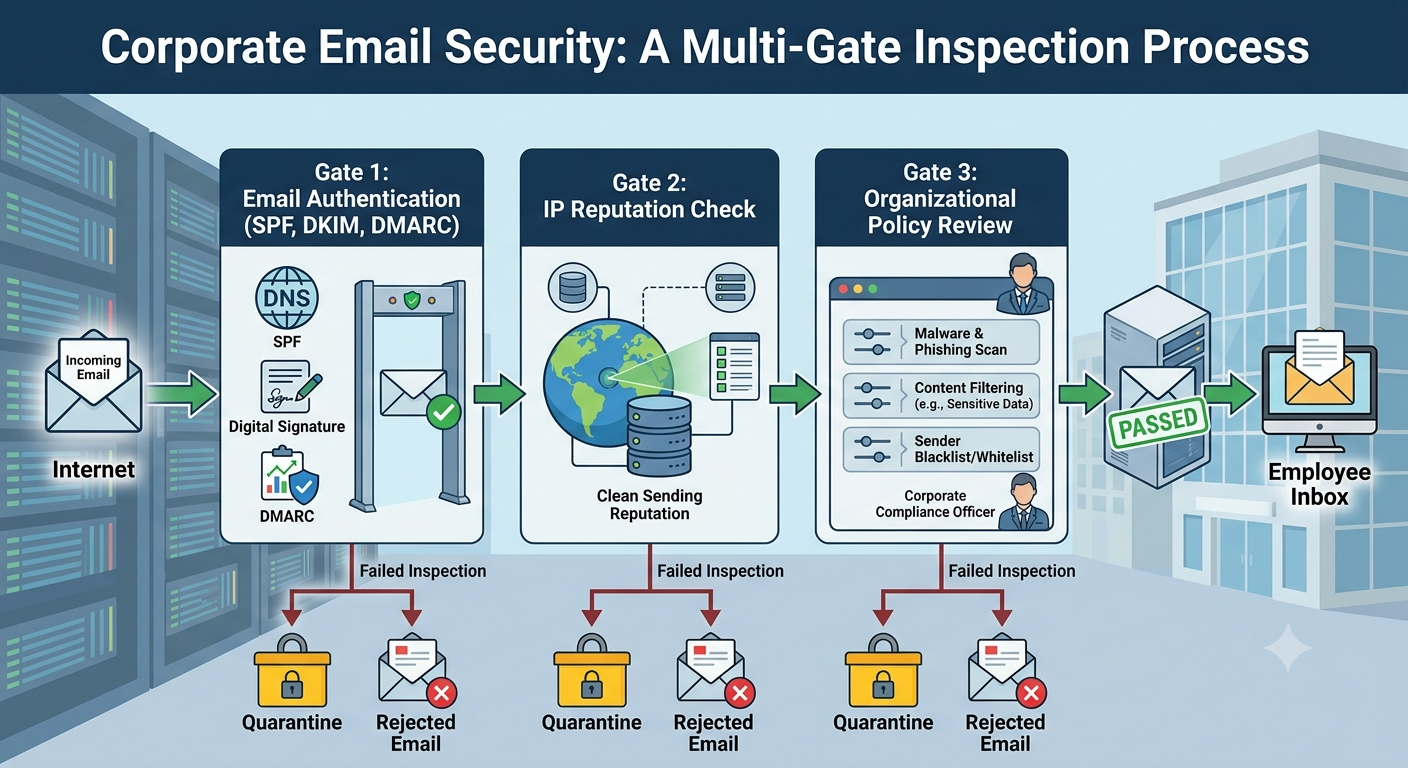
    The deliverability landscape changed permanently in 2024, and tightened again through 2025. What used to be “best practice” is now an enforced gate. If you fail it, your mail doesn’t go to spam — it gets rejected at the door.

    Here’s what the major mailbox providers now demand of anyone sending real volume:

    Google and Yahoo began enforcing their bulk-sender requirements on February 1, 2024. Any domain sending more than 5,000 messages a day to Gmail addresses is classified as a bulk sender — and that classification is permanent, even if your volume later drops. Bulk senders must:
    – Authenticate with both SPF and DKIM (not one or the other)
    – Publish a DMARC record with a policy of at least p=none, aligned with SPF or DKIM
    – Provide one-click unsubscribe (RFC 8058) and honor opt-outs within two days
    – Keep their spam complaint rate below 0.1%, and never let it reach 0.3%
    – Maintain valid PTR (reverse DNS) records and send over TLS

    As of November 2025, Gmail moved from temporary throttling to permanent rejection of mail that fails these checks.

    Microsoft followed with matching rules for Outlook.com, Hotmail, and Live addresses, enforced from May 5, 2025. Non-compliant mail from high-volume senders isn’t filtered to Junk — it’s rejected outright, returning the error 550 5.7.515 Access denied, sending domain does not meet the required authentication level.

    The takeaway for cold senders: authentication is no longer optional, and it’s no longer a differentiator. It’s the cost of being allowed to send at all. Everything in the next section is mandatory.

    SPF, DKIM & DMARC, Set Up Correctly

    These three records work together. SPF says which servers may send for your domain. DKIM cryptographically signs each message so it can’t be altered or forged. DMARC ties the two together, tells receivers what to do when authentication fails, and reports back on who’s sending as you.

    SPF (Sender Policy Framework) is a single DNS TXT record listing your authorized sending sources:

    v=spf1 include:_spf.bulkresponse.com -all
    

    Three mistakes to avoid: publishing more than one SPF record on a domain (only one is valid), exceeding the limit of 10 DNS lookups (stacking too many include: statements silently breaks SPF), and using ~all (softfail) when you should use -all (hardfail). Softfail tells receivers “this is probably unauthorized” — weaker than a firm “reject.”

    DKIM (DomainKeys Identified Mail) signs every outbound message. Use a 2048-bit key — 1024-bit is the bare minimum mailbox providers will accept, and it’s increasingly treated as weak. Your sending platform supplies the DNS record; once it’s live, signing is automatic. Critically, the signing domain (d=) must align with your From address, or you’ll pass DKIM and still fail DMARC.

    DMARC starts in monitoring mode so you can watch for problems before enforcing anything:

    v=DMARC1; p=none; rua=mailto:dmarc@yourdomain.com
    

    After two to four weeks of clean aggregate reports, advance to p=quarantine, then eventually p=reject. In 2026, leaving a domain at p=none indefinitely is itself a yellow flag — providers read it as a sender who collects authentication data but never acts on it. Treat p=none as a starting line, not a destination.

    Domain & Infrastructure Strategy for Cold Senders
     

    This is the section opt-in deliverability guides skip entirely, and it’s the one cold senders most need.

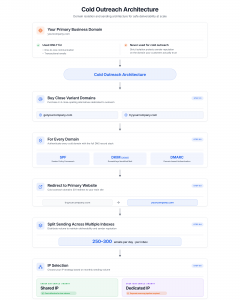
    Never send cold email from your primary business domain. This is the cardinal rule. If your cold outreach damages a domain’s reputation — or gets it onto a blocklist — every email from that domain suffers, including the messages your sales team sends to existing customers and the password resets your app sends to users. Quarantine the risk.

    The standard architecture looks like this:

    • Keep your primary domain (yourcompany.com) clean. Use it only for one-to-one business mail and transactional sending. Never run cold campaigns through it.
    • Register separate sending domains for cold outreach. Buy close variants — getyourcompany.com, tryyourcompany.com, yourcompany.io — and authenticate each one fully (SPF, DKIM, DMARC). These are domains you can afford to rotate or retire if reputation degrades.
    • Set up redirects. Point each sending domain at your primary site so a curious prospect who types it in lands somewhere legitimate.
    • Spread volume across multiple inboxes. Rather than blasting from one address, send a modest daily volume from each of several inboxes across your sending domains. This keeps any single mailbox under the radar and limits the blast radius if one gets flagged.

    On shared vs. dedicated IPs: most cold senders should start on a reputable platform’s shared IPs. Below roughly 50,000 emails a month, you benefit from inheriting an established IP reputation you couldn’t build alone. Move to a dedicated IP only when your volume is consistently high enough (typically 100,000+ a month) to sustain its own reputation — and budget for warming it separately, because a cold dedicated IP starts with no reputation at all.


    Domain Warmup: The Patience Tax You Can’t Skip

    A brand-new sending domain has no reputation, and 2026’s filters scrutinize new domains harder than ever. Send 2,000 cold emails from a fresh domain on day one and you won’t just hit spam — you’ll establish a negative reputation that can take months to undo.

    Warmup is the process of building reputation gradually: start with tiny volumes that earn high engagement, then increase slowly over several weeks. A conservative schedule:

    Week Daily volume per inbox Focus
    1 10–20 Warmup network or known-good contacts; aim for replies
    2 30–50 Mostly warmup, a little real cold sending
    3 75–100 Begin transitioning into live campaigns
    4 150–200 Full cold sending at conservative volume
    5+ 250–300 Scale only if engagement metrics stay healthy

    Three rules make or break warmup:

    • Replies are the goal, not opens. A reply is the strongest positive signal a mailbox provider can see. Automated warmup tools simulate replies; real conversations are better.
    • Don’t stop and restart. Consistency is the entire point. Warm for two weeks, go dark for one, and you’ve reset much of your progress.
    • One inbox is not a strategy. After warmup, ~250–300 sends per inbox per day is a sustainable ceiling. Higher volume means more inboxes, not more mail per inbox.

    List Hygiene: The Highest-Leverage Move You’ll Make

    If you take one thing from this guide, take this: for cold senders, list quality outranks every other variable. You can authenticate perfectly, warm up patiently, and write beautifully — and a dirty list will still sink you. The reverse is also true: a clean, tightly-targeted list forgives a lot of smaller mistakes.

    The reason is mechanical. Sending to dead addresses spikes your bounce rate. Sending to role accounts and unengaged contacts depresses engagement. And sending to spam traps can get you blocklisted in days. All three are far more common on cold lists than on opt-in lists, so hygiene isn’t a nice-to-have — it’s load-bearing.

    Validate Every List Before You Send

    Run every list through a verification service — BulkResponse’s list cleaning, NeverBounce, ZeroBounce, MillionVerifier, or Bouncer — to strip out:

    • Hard bounces — addresses that don’t exist
    • Role accountsinfo@, support@, sales@, admin@; aggressively filtered and rarely useful
    • Catch-all domains — accept everything, so you can’t verify individual mailboxes; segment these and send to them cautiously, if at all
    • Disposable addresses — a sign of a low-quality source
    • Known complainers — addresses on suppression databases

    A raw scraped or purchased list typically loses 15–30% to validation. If your tool removes less than 10%, it’s probably too lenient — or your list is unusually clean (it usually isn’t).

    [DATA PLACEHOLDER — list hygiene impact] Insert a real figure from your own platform here, e.g. “Across campaigns run on BulkResponse, lists validated before sending bounce at roughly X%, versus Y% for unvalidated lists.” This single first-party data point is what will separate this guide from every competitor’s. Pull it from your bounce logs by comparing validated vs. unvalidated jobIds.

    Understand Spam Traps

    Spam traps are addresses created specifically to catch senders with poor list practices. There are two kinds, and both hurt:

    • Pristine traps were never owned by a real person. Hitting one means you scraped or bought a list. Hitting several can blocklist you within days.
    • Recycled traps are once-real addresses that were abandoned, then reactivated as traps by the provider. Hitting them means your list is stale.

    No verification service catches every trap. The only complete defense is sourcing data carefully and keeping lists fresh. (Our breakdown of why every sender needs a list cleaning service goes deeper on the cost of skipping this.)

    Suppress Aggressively and Permanently

    Maintain a global suppression list and apply it to every send. It should include everyone who unsubscribed (legally required), everyone who marked you as spam, every hard bounce, and anyone who’s shown zero engagement across multiple campaigns over six-plus months. On BulkResponse, bounces and complaints are suppressed automatically across all your campaigns; if you’re stitching this together manually, you need a hard process for it, because a single repeated send to a complainer is pure downside.


    Writing Cold Email That Reaches the Inbox

    The spam-word myth needs to die. In 2026, filters don’t keep a banned-word list — “free,” “guarantee,” and “act now” won’t sink a well-reputed sender. Modern filters are machine-learning systems trained on billions of messages, and they react to patterns and reputation, not individual words. That said, format and structure still matter, especially on a cold first touch where you have no reputation cushion.

    For the first cold email in a sequence, lighter is safer:

    • Write it like a human wrote it to one person. Plain, conversational text outperforms designed HTML templates for cold outreach. A message that looks like a personal note triggers fewer filters than one that looks like a marketing blast.
    • Minimize links. One link is plenty for a first touch. Several links in a cold email reads as promotional to both filters and humans.
    • Skip images and tracking pixels on the first touch. Both load as remote content, a mild spam signal when there’s no existing relationship. You can reintroduce light HTML, images, and tracking later in the sequence, once you’re emailing engaged recipients who’ve already replied or opened.
    • No attachments, ever, in cold email. Attach things after someone replies and asks.

    On subject lines: keep them short (under ~50 characters), specific, and free of marketing gloss. “Quick question about your hiring process” will out-deliver and out-reply “🚀 Transform Your Hiring With AI!” every time. For frameworks that consistently earn replies, see our five proven cold email outreach recipes.

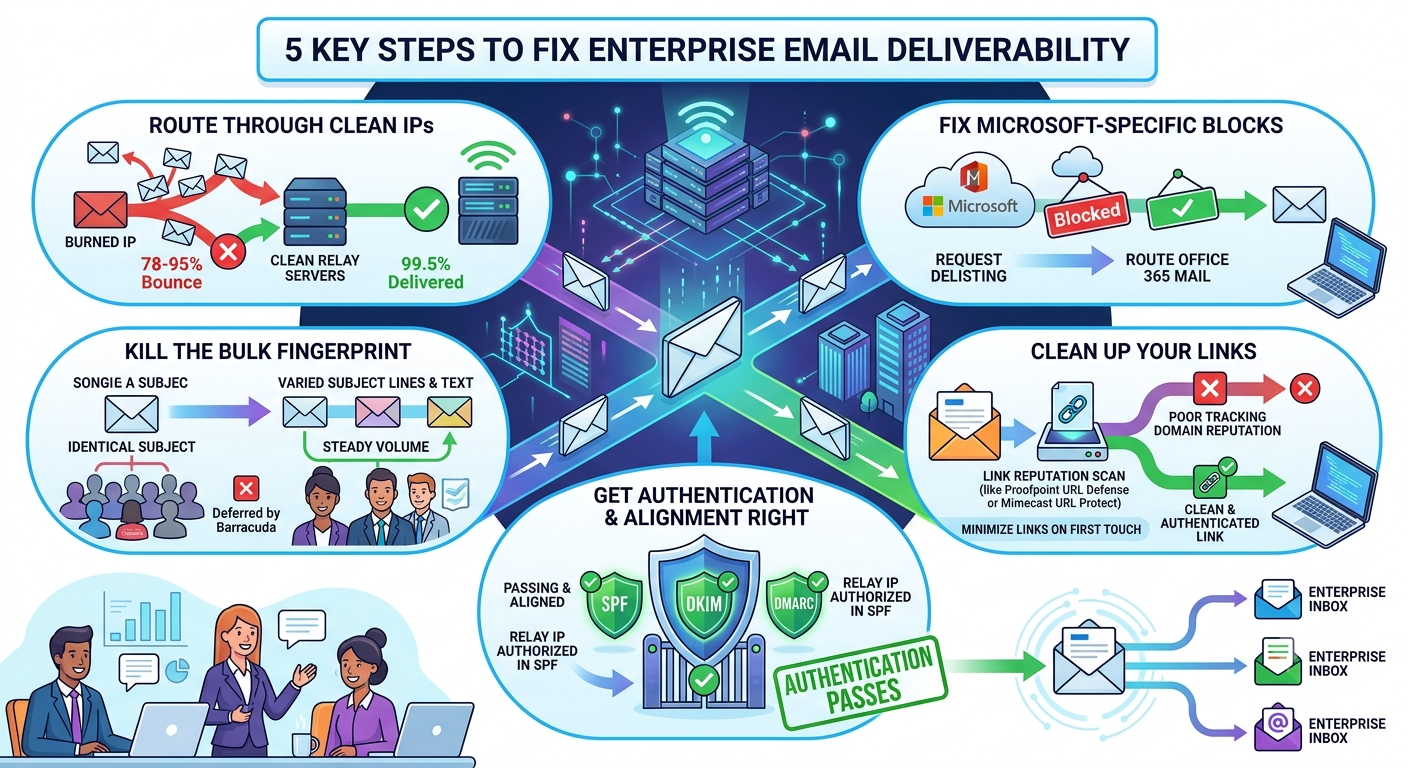
    One more point cold senders get wrong: bulk-identical content is itself a deliverability risk. Sending the exact same body to thousands of recipients is a pattern filters recognize as a blast. Genuine personalization — or at minimum, meaningful variation — breaks that pattern. (Our deep dive on Primary vs. Promotions inbox placement covers exactly how Gmail treats repetitive content.)

    Monitoring & Diagnostics: You Can’t Fix What You Don’t Measure

    Deliverability isn’t set-and-forget. Reputation drifts, lists decay, and a blocklisting can halve your inbox rate overnight. Cold senders need a monitoring discipline.

    Watch your reputation at the source. Google Postmaster Tools shows your domain reputation, spam complaint rate, and authentication status exactly as Gmail sees them — setup takes five minutes and it’s the single most useful free tool you have. Microsoft’s SNDS does the same for Outlook and Hotmail. If you’re not watching both, you’re flying blind.

    Categorize your bounces — they’re a diagnostic goldmine. Not every bounce means the same thing, and parsing them tells you where the real problem is:

    • Bad mailbox — address doesn’t exist. Hard bounce; suppress immediately.
    • Inactive mailbox — exists but dormant. Treat as a hard bounce after one or two attempts.
    • Spam-related — the receiving server rejected for reputation, content, or blocklist reasons. Investigate the root cause; this is the category that signals deliverability trouble.
    • Policy-related — rejected on a domain or content rule. Often fixable.
    • Quota exceeded — mailbox full. Retry later; don’t suppress.
    • Greylisting — temporary deferral; the server will accept on retry.

    Reading the DSN (Delivery Status Notification) fields — dsnMta, dsnStatus, dsnDiag — lets you diagnose problems down to the sending server, IP, or recipient domain, rather than guessing. If your spam-related bounces cluster on one IP or one recipient domain, that’s where to look first.

    [DATA PLACEHOLDER — bounce category breakdown] Drop in a real distribution from your platform here, e.g. a one-line breakdown of bounce categories across a recent sending window. Showing readers what a healthy bounce profile actually looks like — with real numbers — is the kind of first-hand authority that wins both Google rankings and AI-search citations.

    Monitor blocklists weekly. Check your sending IPs and domains against Spamhaus (SBL, XBL, DBL), Barracuda, SpamCop, and SORBS. A single major listing can gut your inbox rate, and catching it early means you can fix the cause and request delisting before the damage compounds. Re-listing happens fast if you delist without fixing the underlying problem (almost always list quality or a volume spike).

    Sign up for feedback loops. FBLs from Microsoft, Yahoo, and others notify you when a recipient marks you as spam, so you can suppress that address before it does more harm.

    Compliance: The Lines Cold Senders Can’t Cross

    Cold email is legal in much of the world, but the rules vary sharply by jurisdiction, and they intersect with deliverability — providers watch for the same signals regulators do.

    CAN-SPAM (United States) is the most permissive. Cold B2B email is allowed, provided you use accurate From/Reply-To information and a truthful subject line, include a valid physical postal address, offer a clear unsubscribe mechanism, and honor opt-outs within 10 business days.

    GDPR (European Union) is stricter. Cold email to EU recipients generally requires a “legitimate interest” basis: the contact must be relevant to their professional role, and you should be able to document why you reached out. Business addresses are defensible; emailing EU citizens at personal addresses (gmail.com, yahoo.com) is far riskier.

    CASL (Canada) is the strictest major regime. Cold email to Canadian recipients without prior consent is generally not permitted. If you have meaningful Canadian volume, get legal advice.

    The pragmatic baseline that keeps you compliant and improves deliverability at the same time: include a real postal address, offer one-click unsubscribe, honor opt-outs immediately, and target business contacts rather than consumer addresses.

    The Cold Email Deliverability Checklist:
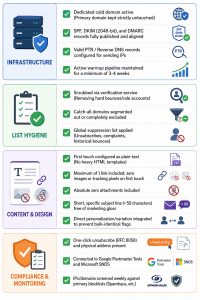
     

    Before you launch a campaign, run this list:

    Infrastructure

    • Sending from a dedicated cold-outreach domain, not your primary domain
    • SPF, DKIM (2048-bit), and DMARC published and passing on every sending domain
    • DMARC alignment verified (send a test to Gmail, check “Show original”)
    • PTR / reverse DNS configured for sending IPs
    • Domains and inboxes warmed for at least 3–4 weeks

    List

    • Validated through a verification service (15–30% removal is normal)
    • Role accounts and disposable addresses stripped
    • Catch-all domains segmented or excluded
    • Global suppression list applied (unsubscribes, complaints, bounces)

    Content

    • First touch is plain-text, one link max, no images or attachments
    • Subject line short, specific, no marketing gloss
    • Meaningful personalization or variation (not bulk-identical)
    • One-click unsubscribe and physical address present

    Monitoring

    • Google Postmaster Tools and Microsoft SNDS connected
    • Blocklist check clean
    • Bounce categorization and FBLs in place

    Troubleshooting: Common Failures and Their Fixes

    “My emails land in Gmail’s Promotions tab.”
    Promotions isn’t spam — it’s delivered — but visibility is lower. The cause is content signals: too many links, heavy HTML, images, marketing language. Fix it by sending plain-text-style first touches with minimal links. See our Primary vs. Promotions guide for the specifics.

    “My reply rate dropped suddenly.”
    Three usual suspects: a reputation hit (check Postmaster Tools), a new blocklist listing (check Spamhaus and others), or a content change that started tripping filters (compare the recent campaign to an older one that worked).

    “My bounce rate is climbing.”
    Almost always a list-quality problem. Re-verify, segment out catch-alls, and audit your data source. Above 5% bounce, stop and clean before sending again.

    “Open rates look fine but replies are flat.”
    Likely Promotions-tab placement, or open-rate inflation from Apple Mail and Gmail prefetching images (which fakes opens). Trust reply rate as the truer signal.

    “My domain got blocklisted.”
    Stop sending immediately. Identify the list, fix the underlying cause (usually a dirty list or a volume spike), then request delisting — most offer self-service removal. Request delisting before fixing the cause and you’ll be relisted within days.

    Frequently Asked Questions

    How long does it take to warm up a new sending domain?
    Three to four weeks to reach basic cold volume (100–200/day per inbox), and six to eight weeks to scale higher safely. Skipping warmup almost always causes spam placement that takes months to recover from.

    What’s a good inbox placement rate for cold email?
    Above 85% is excellent, 70–85% is solid, and below 70% means you have problems to fix. Anyone promising 95%+ across every provider is either measuring wrong or selling something.

    Can I send cold email from Gmail or Google Workspace?
    For light, genuinely one-to-one outreach, yes. For anything at volume, no — Workspace caps daily sending (~2,000 messages with throttling) and Google may suspend accounts doing mass cold outreach. Use dedicated cold infrastructure instead. Our ultimate guide to cold email outreach covers the full setup.

    Why did Mailchimp / SendGrid / Brevo suspend my account?
    Because their terms prohibit cold and non-opt-in sending, and they enforce it to protect the shared IP reputation all their customers share. It’s not a glitch — it’s the business model. Cold senders need infrastructure built for cold sending.

    How many cold emails can I safely send per day?
    After full warmup, about 250–300 per inbox per day. Scale by adding inboxes across multiple sending domains, not by pushing a single inbox harder.

    Does email tracking hurt deliverability?
    On a cold first touch, yes — slightly. Tracking pixels load as remote images, a mild spam signal with no prior relationship. Skip tracking on first touches; it’s fine on follow-ups to engaged recipients.

    What’s the difference between SPF, DKIM, and DMARC?
    SPF lists which servers may send for your domain. DKIM cryptographically signs each message. DMARC tells receivers what to do when SPF or DKIM fails and reports who’s sending as you. In 2026, all three are mandatory for any real sending volume.

    The Bottom Line

    Cold email deliverability isn’t a setup you complete once — it’s a discipline you maintain. The senders who consistently reach the inbox are the ones who authenticate properly, warm up patiently, validate every list, send relevant and human-looking mail to well-targeted people, monitor their reputation obsessively, suppress without mercy, and run it all on infrastructure built for cold sending.

    Miss any one of those and you’ll fight the spam folder forever. Get them all right and cold email becomes one of the most reliable, lowest-cost channels in B2B.

    For more on the habits behind consistent sending, see 7 habits of highly successful email marketers.


    BulkResponse is built for senders who can’t risk account suspension. Cold lists, bulk lists, and non-opt-in outreach are supported by default — no surprise bans. Explore our cold email software, SMTP relay service, list cleaning, and pricing to get started.


     

  • 10 AI Cold Email Tips Marketers Are Secretly Using to Outperform Everyone

    Cold email marketing isn’t what it used to be.

    Gone are the days when blasting a generic email to a huge list got results.

    Today, the best marketers are quietly using AI-powered tools to craft smarter, more human, and more effective cold email campaigns — and they’re seeing massive jumps in reply rates while others still struggle to land in the inbox.

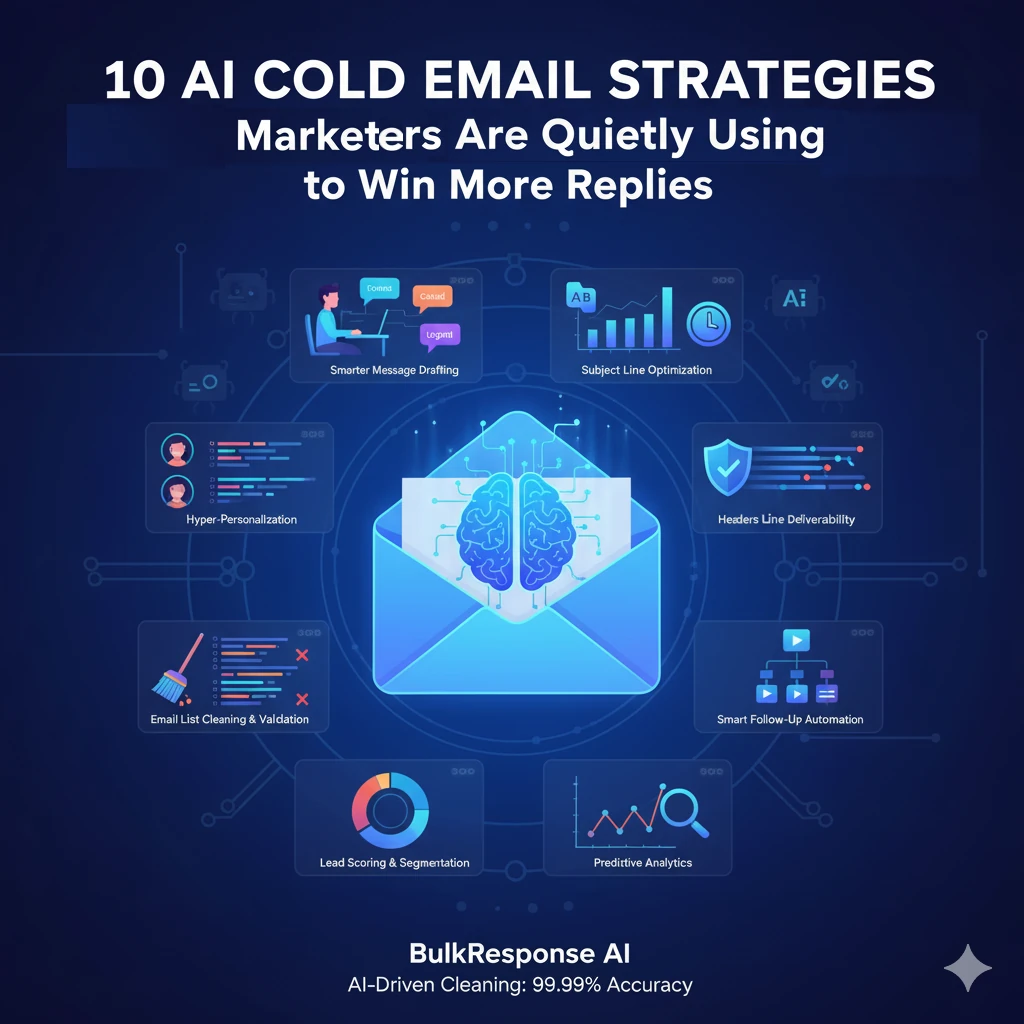
    Here’s a look at the 10 AI cold email tips top marketers are secretly using right now 👇


    1. Using AI to Draft Emails That Actually Sound Human

    1. Using AI to Draft Emails That Actually Sound Human

    Modern AI tools can analyze tone, intent, and structure — helping you write emails that sound conversational rather than robotic.

    Marketers feed in short prompts like “Write a friendly outreach email for SaaS founders” and get near-perfect drafts ready to personalize.

    The best part? It cuts writing time by 80% while keeping brand voice consistent.

    2. Crafting Magnetic Subject Lines with AI

    2. Crafting Magnetic Subject Lines with AI

    AI models trained on millions of subject lines can predict which ones will get the most opens.

    Marketers are using these tools to test tone (curiosity, urgency, value), run A/B tests automatically, and score subject lines before sending.

    Think of it as your built-in copy chief — minus the guesswork.

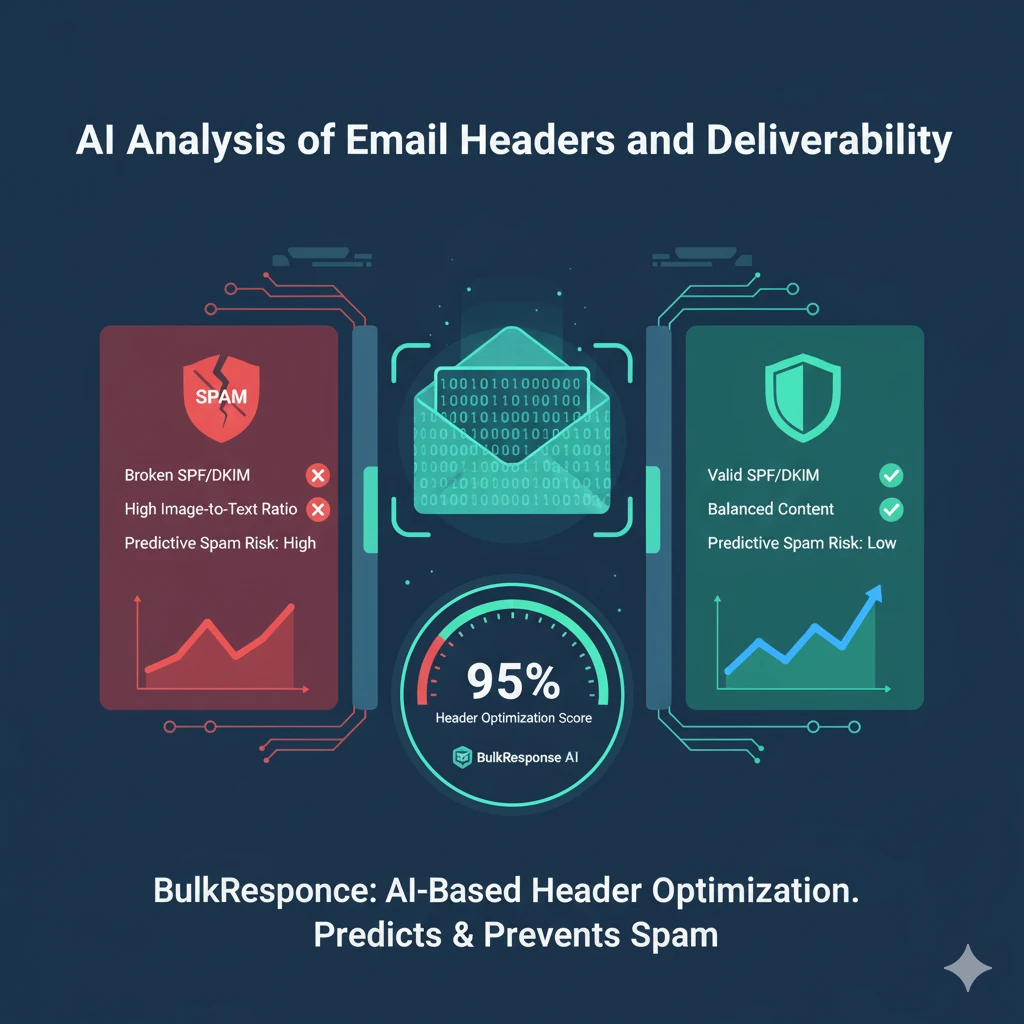
    3. Analyzing Email Headers for Better Deliverability

    3. Analyzing Email Headers for Better Deliverability

    Before hitting “send,” smart marketers run their emails through AI-based header analyzers that flag potential spam triggers.

    AI models detect issues like mismatched domains, DKIM errors, or wording that could trigger filters — saving campaigns from the dreaded Promotions tab.

    Tools like BulkResponse’s AI header insight make this process seamless.

    4. Personalizing at Scale with AI

    Gone are the days of “Hey {{first_name}}.”

    AI can now analyze a prospect’s company website, role, or recent activity and generate custom intros or compliments.

    It’s like having a personal researcher for every email — without the manual effort.

    That’s how marketers personalize thousands of emails and still sound 1-to-1 human.

    5. Optimizing Send Times with Machine Learning

    AI tracks when your recipients open and engage with emails.

    By learning those patterns, it automatically schedules your campaigns to hit inboxes at their most active hours — not yours.

    This tiny tweak often lifts open rates by 15–25%.

    6. Automating Follow-Ups That Feel Natural

    The pros don’t manually write follow-ups anymore.

    AI learns from the tone of previous emails and generates gentle, natural-sounding nudges like:

    “Hey Sarah, just checking if you got a chance to look at my previous note — totally fine if it’s not a priority right now.”

    No templates, no spammy feel — just contextual follow-ups written by AI.

    7. Scoring Leads with Predictive AI

    Instead of emailing everyone on a list, AI can now rank contacts by their likelihood to respond based on engagement signals, job title, or past behavior.

    This helps marketers focus on high-intent prospects and boost conversion rates without expanding send volume.

    8. Predicting Campaign Performance Before Launch

    Marketers are using AI to run pre-send simulations.

    The system predicts open and reply rates based on tone, structure, and previous campaigns — letting you fix weak spots before you even send a single email.

    It’s like having a “future forecast” for your campaign.

    9. Gathering Market Insights from AI

    AI tools scrape thousands of competitor emails and industry trends to uncover what’s working — from tone to structure to offer type.

    Marketers use these insights to stay one step ahead, writing emails that stand out from the flood of look-alikes in every inbox.

    10. Cleaning Email Lists with AI Precision

    Deliverability starts with clean data.

    AI-driven validation systems can now detect disposable, spam-trap, or risky emails with 99.99% accuracy.

    Marketers using tools like BulkResponse’s AI List Cleaner have seen massive drops in bounce rates and higher inbox placement — because no campaign wins if half your emails never reach inboxes.


    Final Thoughts

    AI isn’t replacing email marketers — it’s amplifying them.

    Those who learn how to blend AI tools with human strategy are outperforming the rest by a mile.

    If you’re still writing, testing, or cleaning manually — it’s time to level up.


    Ready to Experience AI-Powered Email Like Never Before?

    At BulkResponse, we’ve built one of the industry’s most advanced AI-powered Spintax Generators, designed to make every email unique, natural, and inbox-friendly.

    Learn more here:

    How BulkResponse’s AI Spintax Generator Works (and Why No Other Service Matches It)

    Start sending smarter — because while others are guessing, you’ll be automating success with AI.

    Ready to Boost Your Email Marketing?

    Start your journey with BulkResponse today and see how our services can help you achieve your marketing goals.

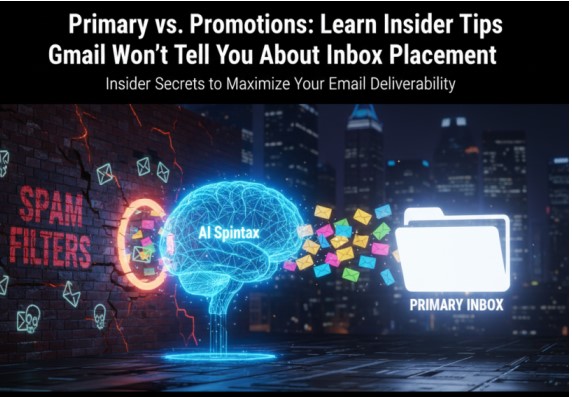
  • Primary vs. Promotions: Learn Insider Tips Gmail Won’t Tell You About Inbox Placement

    Ever wonder why some of your emails land perfectly in the primary inbox while others get relegated to the Promotions tab? It’s a frustrating mystery for many marketers. Gmail’s algorithms are complex and ever-evolving, but there are

    indeed insider tips that can significantly improve your chances of landing where you want to be. It’s not just about avoiding spam; it’s about understanding how Gmail categorizes and values your messages. Let’s uncover some of these secrets.

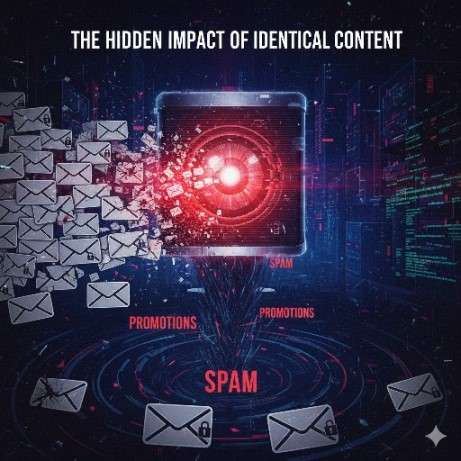
    1. The Hidden Impact of Identical Content

    1. The Hidden Impact of Identical Content

    Gmail’s sophisticated filters are constantly looking for patterns. One of the biggest red flags? Sending the exact same subject line and body text to a large number of recipients. While it might seem efficient, Gmail sees this repetition as a strong indicator of bulk messaging, often leading to the Promotions tab, or worse, the Spam folder. The more unique your emails appear, the less likely they are to be grouped and filtered.

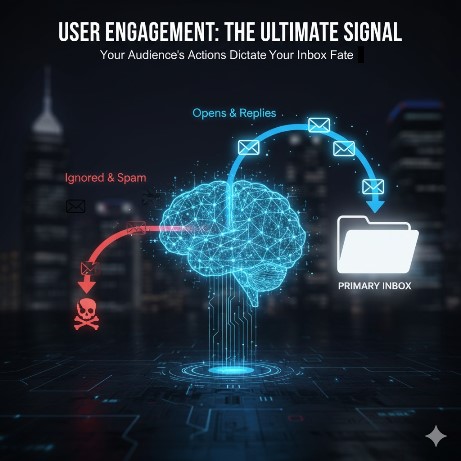
    2. User Engagement: The Ultimate Signal

    2. User Engagement: The Ultimate Signal

    Gmail heavily prioritizes user engagement. If recipients consistently open, reply, forward, or move your emails from Promotions to Primary, Gmail learns that your messages are valuable. Conversely, if emails are consistently ignored, deleted without opening, or marked as spam, your sender reputation takes a hit, making future inbox placement more challenging. Encourage interaction and make your content genuinely appealing.

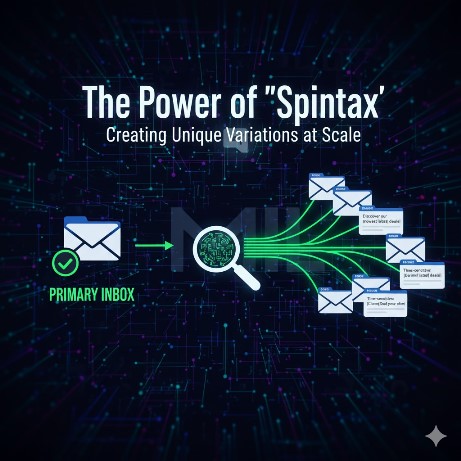
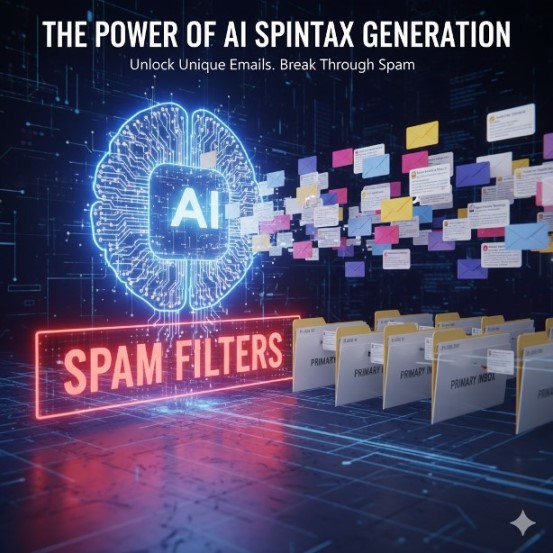
    3. The Power of "Spintax": Creating Unique Variations at Scale

    3. The Power of “Spintax”: Creating Unique Variations at Scale

    This is where a technique like “spintax” becomes invaluable. Spintax allows you to create numerous unique versions of your email’s subject line and body text from a single template. By rotating words, phrases, and even sentence structures, each email sent appears distinct to Gmail’s filters. This breaks the repetitive patterns that spam filters thrive on, making your campaigns feel more organic and less like a bulk send.

    4. Sender Reputation and Domain Health

    4. Sender Reputation and Domain Health

    Your sender reputation is paramount. Gmail closely monitors your domain’s sending history, bounce rates, spam complaint rates, and whether your domain is properly authenticated (SPF, DKIM, DMARC). A poor sender reputation is a one-way ticket to the Promotions or Spam folders. Consistently sending high-quality, relevant, and non-repetitive content helps build and maintain a strong reputation, signaling to Gmail that you’re a trustworthy sender.

    AI Spintax: Automating Personalization for Primary Inbox Success

    5. AI Spintax: Automating Personalization for Primary Inbox Success

    Manually crafting hundreds of variations for spintax can be daunting. This is where AI Spintax Generators become a game-changer. These tools use artificial intelligence to instantly create a multitude of unique subject lines and body text variations, mimicking natural language. This not only saves immense amounts of time but also ensures a higher degree of uniqueness, helping your emails bypass sophisticated filters and land directly in the Primary inbox with less effort and greater impact.


    Conclusion: Master Your Inbox Placement

    Navigating Gmail’s intricate inbox placement rules can feel like a guessing game, but it doesn’t have to be. By understanding the critical role of unique content, user engagement, and a pristine sender reputation, you can significantly elevate your email marketing success. The old tactic of sending identical emails en masse is a relic of the past; today’s digital landscape demands smarter, more personalized approaches.

    To truly master your inbox placement and ensure your messages consistently land in the Primary tab, leveraging advanced tools is no longer a luxury—it’s a necessity. At Bulk Response, our AI Spintax Generator is specifically designed to tackle these challenges head-on. It empowers you to effortlessly create the diverse, unique email variations required to bypass sophisticated spam filters, boost engagement, and protect your vital sender reputation. Stop fighting the filters and start working with intelligent solutions.

    Ready to transform your email deliverability and finally get your messages seen?

    Discover how Bulk Response can put your emails exactly where they belong: in the Primary inbox. Visit us at www.bulkresponse.com to learn more and get started today!

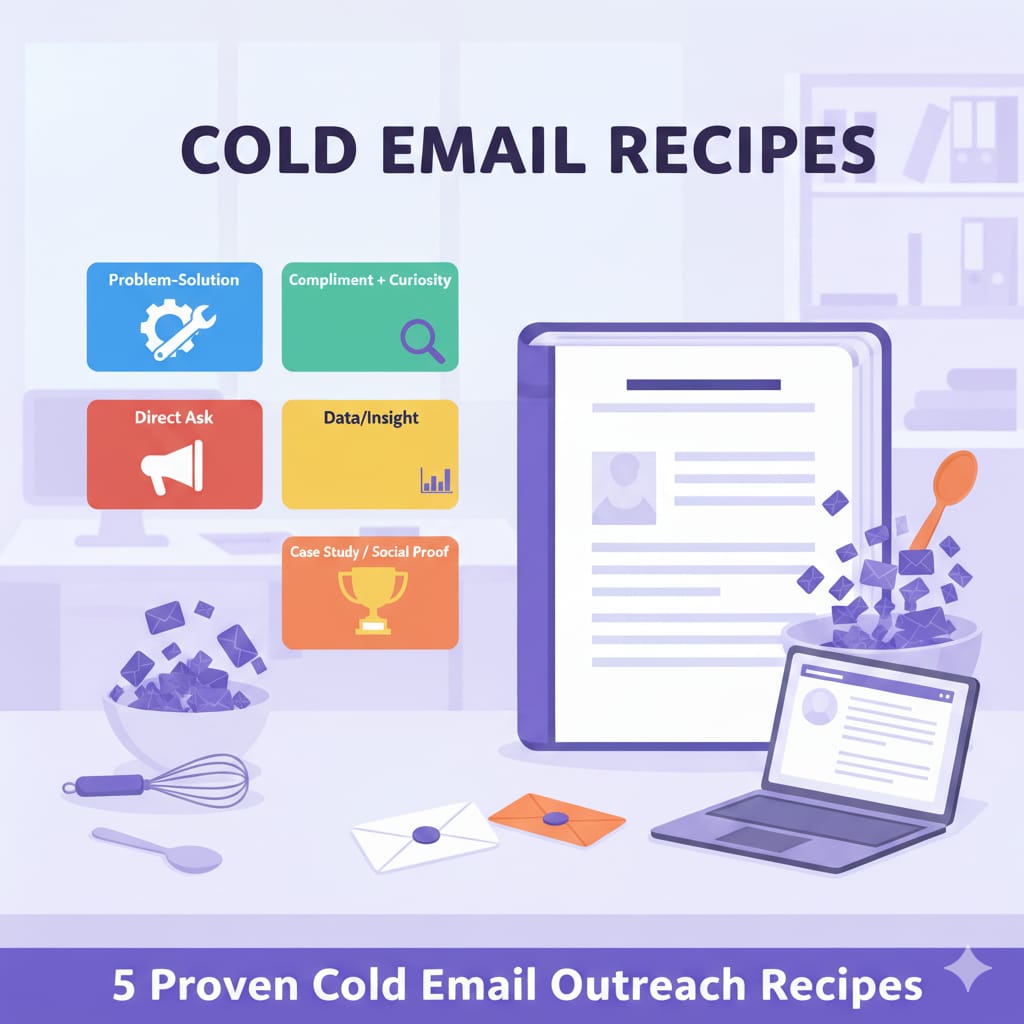
  • 5 Proven Cold Email Outreach Recipes That Actually Get Replies

    5 Proven Cold Email Outreach Recipes That Actually Get Replies

    Cold emailing can feel like shooting arrows in the dark — sometimes you hit the mark, but most of the time your message gets ignored. The truth is, most cold emails fail not because the product is bad, but because the approach is too generic.

    If you want to stand out in a crowded inbox, you need structure, personalization, and clarity. That’s where outreach “recipes” come in — simple, repeatable frameworks you can adapt for different industries, goals, and audiences.

    Here are 5 cold email outreach recipes you can swipe and use today:

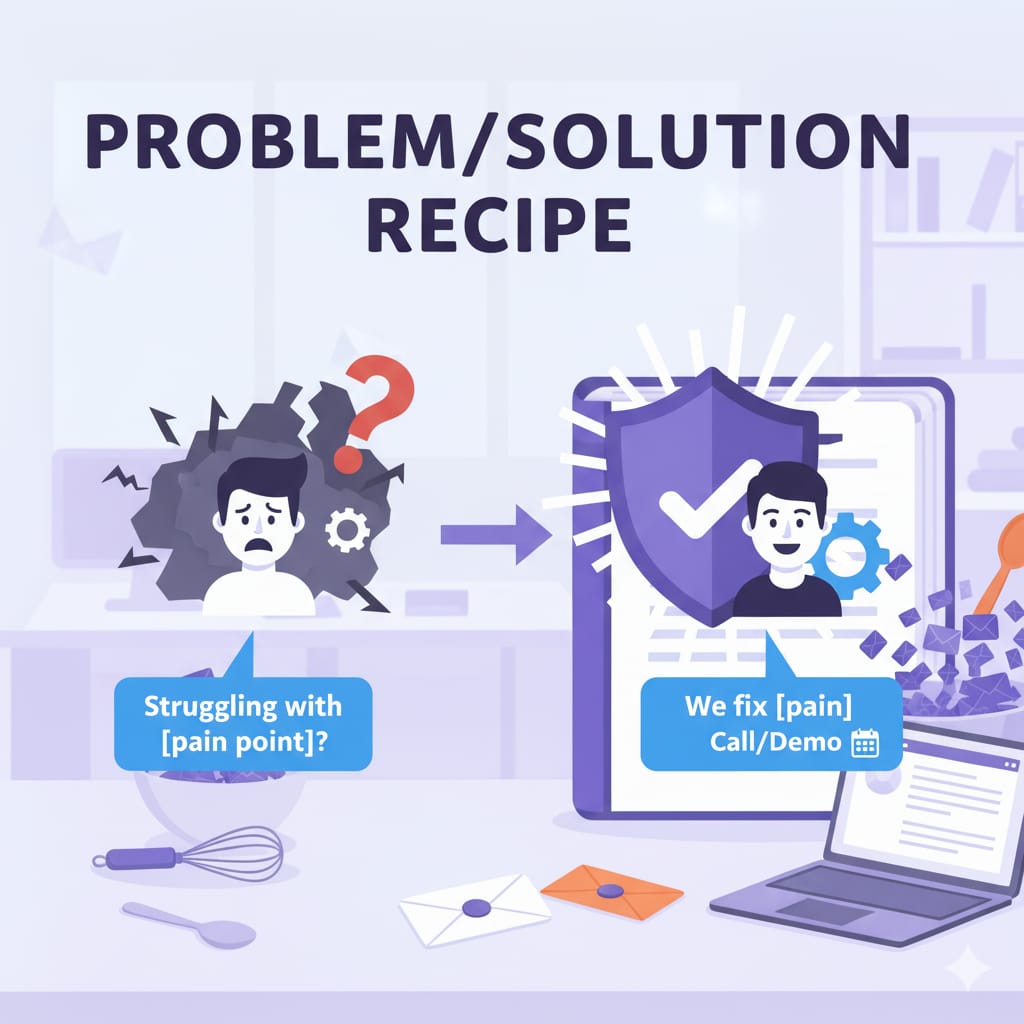
    The Problem–Solution Recipe

    The Problem–Solution Recipe

    When to use it: When you know your prospect’s pain point and can position your product as the fix.

    How it works:

    Subject line: Mention their problem directly.

    Opener: Show empathy and that you understand their struggle.

    Body: Present your solution briefly (1–2 sentences).

    CTA: Ask for a short call/demo.

    Example:
    Subject: Struggling with [pain point]?

    Hi [Name],
    Many [role/industry] spend hours dealing with [challenge]. We’ve helped teams like [X] cut that time by [specific metric].

    Would it make sense to show you how this could work for [company]?

    The Compliment + Curiosity Recipe

    The Compliment + Curiosity Recipe

    When to use it: When you want to build rapport first before making an ask.

    How it works:

    Subject line: Personalized hook.

    Opener: Compliment something specific (post, project, or achievement).

    Body: Connect their success to your solution.

    CTA: Ask if they’re open to a short chat.

    Example:
    Subject: Loved your recent [project/article]

    Hi [Name],
    Your [initiative/post] on [topic] was impressive. It looks like you’re making real progress in [area].

    We work with similar teams and help them [specific outcome]. Curious if you’d be open to a 10-minute chat?

    The Data/Insight Recipe

    The Data/Insight Recipe

    When to use it: When you want to lead with value by sharing insights or benchmarks.

    How it works:

    Subject line: “Quick insight on [topic]”

    Opener: Share a surprising stat or trend relevant to them.

    Body: Explain how your solution helps them act on it.

    CTA: Offer to share a deeper breakdown.

    Example:
    Subject: Quick insight on [topic]

    Hi [Name],
    Did you know [stat/trend] is impacting [industry]? Many companies miss opportunities because of [gap].

    We built [solution] to solve exactly that. Want me to share how [client] improved their results?

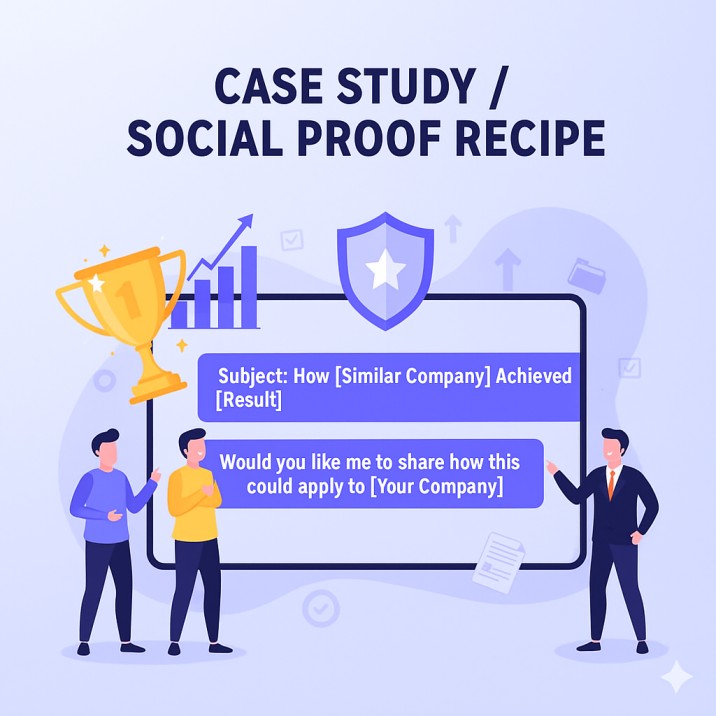
    The Case Study / Social Proof Recipe

    The Case Study / Social Proof Recipe

    When to use it: When credibility matters most and you have strong client success stories.

    How it works:

    Subject line: “How [similar company] achieved [result]”

    Opener: Reference a relevant case study.

    Body: Share the challenge → solution → result in 2–3 lines.

    CTA: Ask if they’d like to explore similar outcomes.

    Example:
    Subject: How [similar company] boosted [metric] by 42%

    Hi [Name],
    We worked with [Client] who struggled with [challenge]. After implementing [solution], they achieved [result].

    Would you like me to share how this could apply to [company]?

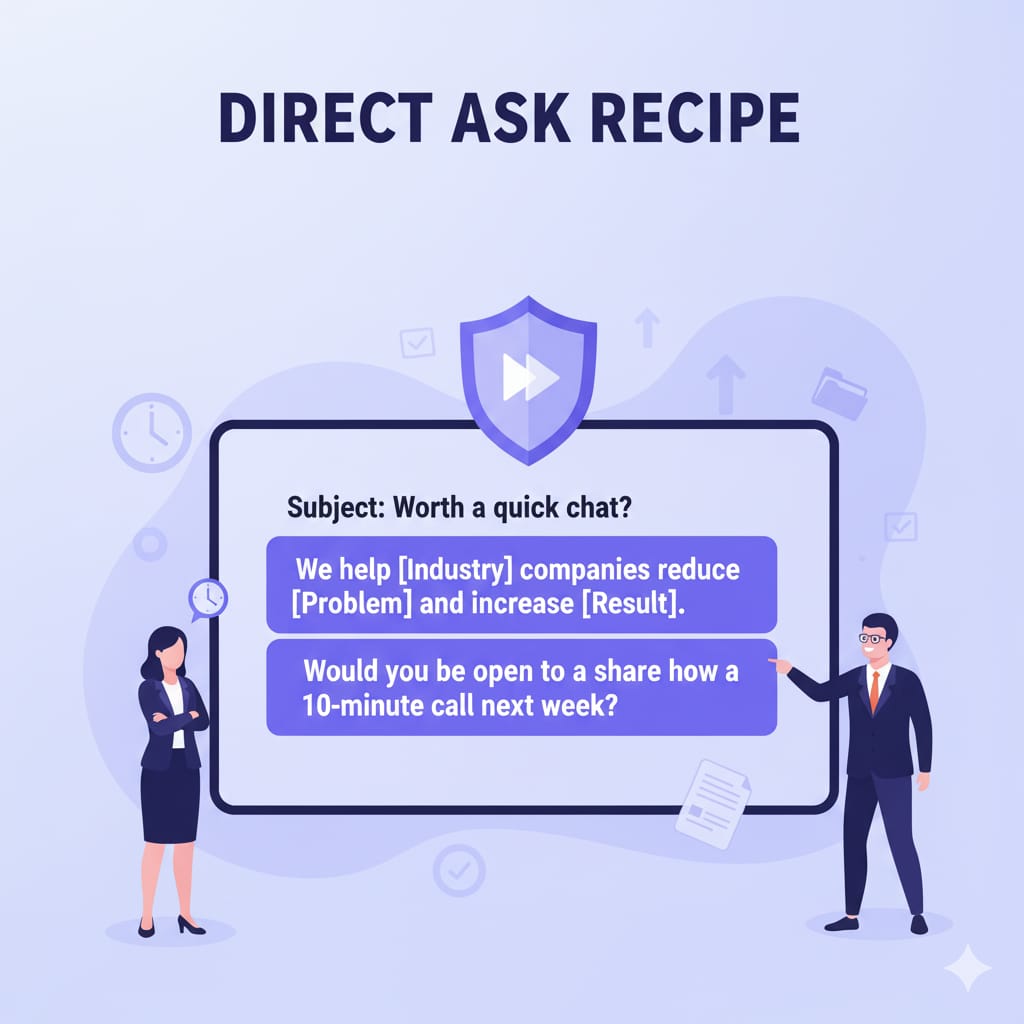
    The Direct Ask Recipe

    The Direct Ask Recipe

    When to use it: When your audience is busy executives and you want to cut to the chase.

    How it works:

    Subject line: “Worth a quick chat?”

    Opener: One-liner about what you do.

    Body: One-liner about the value you bring.

    CTA: Directly ask for a quick call.

    Example:
    Subject: Worth a quick chat?

    Hi [Name],
    We help [industry] companies reduce [problem] and increase [result].

    Would you be open to a 10-minute call next week to see if this makes sense for [company]?

    Bonus: 15 Subject Lines for Cold Email Outreach

    Struggling with [pain point]?

    Quick insight on [industry trend]

    How [competitor/similar company] boosted [metric]

    Loved your recent [post/project]

    Worth a quick chat?

    Cut [pain point] time by 40%

    Helping [role] teams save hours each week

    Is [challenge] slowing you down?

    3 ideas to improve [specific area]

    How we helped [company] achieve [result]

    Can I send you a quick breakdown?

    Boost [metric] without extra workload

    Saw your work on [initiative] — quick thought

    Making [problem] a thing of the past

    Would you like a 10-minute idea exchange?

    Final Thoughts

    Cold email doesn’t have to be cold. By using these 5 simple recipes — Problem–Solution, Compliment + Curiosity, Data/Insight, Case Study, and Direct Ask — you’ll instantly improve your chances of standing out, connecting, and booking meetings.

    The secret? Personalization + clarity + value. Start small, test your outreach, and refine your approach. Soon, your cold emails will start getting warmer replies.


    Ready to Scale Your Outreach?

    If you want to send bulk cold emails that still feel personal, track engagement, and improve deliverability — try BulkResponse.

    With BulkResponse, you can:
    ✅ Upload and manage your email lists
    ✅ Personalize cold email campaigns at scale
    ✅ Authenticate domains for better inbox placement
    ✅ Warm up new email accounts safely
    ✅ Track opens, clicks, and replies in real-time

    👉 Start your next cold email campaign with BulkResponse today and watch your outreach turn into real conversations.

  • The Power of Personalization in Email Marketing: Why It’s a Game-Changer

    The Power of Personalization in Email Marketing: Why It’s a Game-Changer

    In the evolving landscape of digital marketing, one trend is redefining how brands communicate with their audience: personalization in email marketing. Gone are the days when a generic email blast could capture attention. Today’s consumers demand relevance, value, and connection, making personalized email campaigns the cornerstone of successful marketing strategies.


    Why Personalization Matters in Email Marketing

    1. Increased Engagement

    Personalized emails perform significantly better than generic ones. Studies show that emails with personalized subject lines are more likely to be opened and engaged with, leading to higher click-through rates. By addressing the recipient directly and tailoring content to their preferences, brands can foster a sense of connection.

    2. Improved Deliverability

    Emails tailored to individual behaviors and preferences are less likely to be marked as spam. Using advanced tools and techniques, marketers can leverage reliable services to ensure that personalized content reaches the inbox, not the junk folder.

    3. Higher ROI

    Investing in personalization pays off. By segmenting audiences and using dynamic content, businesses can see a measurable increase in revenue from email campaigns. Personalized email marketing campaigns generate more than six times the ROI of non-targeted campaigns, making it a vital strategy for businesses of all sizes.


    The Tools Behind Personalization

    To achieve effective personalization, marketers rely on sophisticated tools and platforms that integrate data analytics and email automation. Advanced solutions allow businesses to:

    • Segment mailing lists based on user behavior and demographics.
    • Automate emails triggered by specific actions, such as cart abandonment or product browsing.
    • Use advanced platforms for efficient and reliable email delivery.

    Platforms offering these services have become essential for executing successful email marketing strategies.


    Best Practices for Personalization

    1. Segment Your Audience

    The foundation of effective personalization is understanding your audience. Use a mailing list service to organize subscribers based on factors like location, purchase history, and engagement levels.

    2. Leverage Dynamic Content

    Dynamic content allows marketers to insert personalized elements into emails, such as product recommendations or special offers. This ensures each recipient gets content that resonates with their interests.

    3. Optimize for Deliverability

    Using a reliable platform and focusing on email best practices ensures that personalized emails are not only sent but also received and opened. Avoid common pitfalls like spam triggers and poor email design.

    4. Track and Adjust

    Data is your best friend in email marketing. Monitor the performance of your email campaigns, analyze what works, and make adjustments to improve future campaigns.


    The Future of Email Marketing

    As consumers continue to demand tailored experiences, personalization in email marketing will remain a dominant trend. Businesses that adopt and refine their personalization strategies will not only increase their engagement but also build lasting relationships with their audience.


    Conclusion: Why BulkResponse is Your Partner in Personalization

    For businesses looking to leverage the full power of personalization, BulkResponse offers a complete suite of tools and services tailored to modern email marketing needs. From reliable SMTP services to advanced bulk mailing capabilities, BulkResponse makes it easier to design, execute, and monitor personalized campaigns.

    Whether you’re sending email blasts, managing sophisticated email marketing campaigns, or looking for the best email marketing solutions, BulkResponse has the platform to help you succeed. Ready to take your email marketing to the next level? Explore BulkResponse today and unlock the potential of personalized email communication!

  • Top 10 Email Marketing Trends to Watch in 2024

    Top 10 Email Marketing Trends to Watch in 2024

    Email marketing continues to be a powerhouse for driving conversions and nurturing customer relationships. However, with increasing competition, brands must stay ahead by adopting innovative strategies. Here’s a detailed look at the top trends shaping email marketing in 2024 and how you can leverage them to maximize your campaign success.

    1. AI-Powered Personalization

    Artificial intelligence has transformed the way businesses approach email marketing. With AI, brands can analyze vast amounts of data to understand customer preferences, behaviors, and buying patterns.

    • Example: A clothing brand could use AI to recommend items based on a customer’s browsing history, tailoring each email to individual tastes.
    • Actionable Tip: Use AI-powered tools like BulkResponse to segment your audience and create highly personalized email campaigns.
    • Stat: Emails with personalized subject lines are 26% more likely to be opened.

    2. Interactive Email Content

    Interactive emails encourage users to engage directly within the email, reducing friction and improving click-through rates.

    • Examples: Embedded polls, clickable image carousels, and “scratch to reveal” discounts.
    • Actionable Tip: Add an interactive quiz to your emails, guiding users to the most relevant product or service based on their answers.
    • Stat: Interactive emails see a 73% higher click-to-open rate compared to static ones.

    3. Minimalistic Design

    In a world cluttered with information, simplicity stands out. Minimalistic designs help focus the reader’s attention on the most critical elements.

    • Examples: Single-column layouts, ample white space, and clear call-to-action (CTA) buttons.
    • Actionable Tip: Avoid overwhelming your subscribers with too much information. Keep the design clean, with one primary message and CTA.
    • Stat: Emails with a simple design and clear CTA increase conversions by up to 32%.

    4. Mobile Optimization

    More than 58% of email opens happen on mobile devices, making mobile optimization critical for success.

    • Examples: Responsive design, short subject lines, and thumb-friendly buttons.
    • Actionable Tip: Test your emails across different devices and screen sizes to ensure they are fully optimized for mobile.
    • Stat: Emails optimized for mobile are 15% more likely to be read within the first three hours of delivery.

    5. Enhanced Data Privacy

    With regulations like GDPR, CCPA, and similar laws worldwide, businesses must prioritize data privacy and transparency.

    • Examples: Clear opt-in processes, easy-to-find unsubscribe buttons, and privacy policy links.
    • Actionable Tip: Reassure subscribers about how their data will be used and stored to build trust.
    • Stat: 72% of customers are more likely to engage with brands that are transparent about their data policies.

    6. User-Generated Content (UGC)

    UGC adds authenticity and trustworthiness to your campaigns, encouraging others to engage with your brand.

    • Examples: Customer testimonials, photos of people using your product, and user-submitted reviews.
    • Actionable Tip: Run a social media campaign inviting customers to share photos with your product, and feature the best entries in your emails.
    • Stat: UGC-based emails receive a 25% higher conversion rate than traditional marketing emails.

    7. Advanced Segmentation

    Basic segmentation is no longer enough. Advanced segmentation allows you to create hyper-specific campaigns based on customer behavior and preferences.

    • Examples: Segmenting by past purchase history, email engagement, or browsing behavior.
    • Actionable Tip: Use BulkResponse’s segmentation tools to send emails that feel tailor-made for each subscriber.
    • Stat: Segmented email campaigns drive 760% more revenue than generic ones.

    8. Automated Drip Campaigns

    Drip campaigns nurture leads by delivering a series of automated, pre-written emails based on specific triggers.

    • Examples: A welcome series for new subscribers or a cart abandonment sequence for online shoppers.
    • Actionable Tip: Set up a drip campaign for your highest-performing content to keep your audience engaged over time.
    • Stat: Businesses using automated campaigns see a 34% increase in sales.

    9. Video Content Integration

    Video content grabs attention like no other medium. Including videos in your emails can dramatically boost engagement.

    • Examples: A product demo video, behind-the-scenes footage, or customer testimonials.
    • Actionable Tip: Use a thumbnail with a play button overlay to encourage clicks, linking to a landing page with the full video.
    • Stat: Emails with video have a 300% higher click-through rate.

    10. Accessibility and Inclusivity

    Creating accessible emails ensures that all users, including those with disabilities, can engage with your content.

    • Examples: Proper alt text for images, high-contrast color schemes, and legible fonts.
    • Actionable Tip: Test your emails with accessibility tools to ensure compliance with best practices.
    • Stat: Brands that focus on accessibility see a 12% increase in customer satisfaction.

    Why These Trends Matter

    Email marketing is not just about delivering messages; it’s about creating meaningful experiences for your subscribers. By embracing these trends, businesses can strengthen customer relationships, boost ROI, and stand out in crowded inboxes.

    Bulkresponse Email List Cleaning

    How BulkResponse Can Help

    BulkResponse.com offers cutting-edge tools to implement these trends seamlessly. From AI-powered personalization to advanced segmentation and automation, BulkResponse makes email marketing smarter and more effective. Sign up today and take your campaigns to the next level!

    Final Thoughts

    Email marketing in 2024 is all about staying dynamic and user-focused. By leveraging these trends, your business can not only engage better with its audience but also drive conversions like never before. Visit BulkResponse now and see how you can revolutionize your email campaigns.

  • The Ultimate Guide to Bulk Email Marketing

    The Ultimate Guide to Bulk Email Marketing

    Bulk Email Marketing

    Introduction

    In the digital age, email marketing remains one of the most effective tools for businesses to reach their audience. Bulk email marketing, in particular, allows companies to send a single message to thousands of recipients simultaneously, maximizing their reach and impact. However, understanding best practices and avoiding common pitfalls is crucial to leverage this tool effectively. This guide will give you everything you need to know about bulk email marketing and how to implement it successfully.

    What is Bulk Email Marketing?

    Bulk email marketing involves sending many emails to a broad audience at once. This method is ideal for newsletters, promotional campaigns, and any other content intended for a wide audience. BulkResponse specializes in providing high deliverability rates, ensuring your emails reach your audience’s inbox rather than their spam folders.

    Benefits of Bulk Email Marketing

    1. Cost-Effective: Compared to other forms of marketing, bulk email marketing is highly cost-effective. You can reach thousands of potential customers without incurring significant costs.
    2. High ROI: Email marketing generally offers a high return on investment. According to the DMA, for every $1 spent on email marketing, the average return is $42.
    3. Measurable Results: With tools like BulkResponse’s advanced analytics, you can track the performance of your email campaigns in real-time.
    4. Personalization: Despite its mass nature, bulk email marketing allows for a degree of personalization, enhancing engagement rates.

    Best Practices for Bulk Email Marketing

    1. Build a Quality Email List
      • Use sign-up forms on your website.
      • Offer incentives for subscribers.
      • Ensure you have permission to email your contacts.
    2. Segment Your Audience
      • Divide your list based on demographics, past interactions, and preferences. This allows for more targeted and effective campaigns.
    3. Craft Compelling Subject Lines
      • Your subject line is the first thing recipients see. Make it engaging and relevant to increase open rates.
    4. Design Mobile-Friendly Emails
      • Ensure your emails look good on both desktop and mobile devices. A significant portion of your audience will read emails on their smartphones.
    5. Monitor Your Metrics
      • Track open rates, click-through rates, bounce rates, and unsubscribe rates. Use this data to refine your strategies.
    6. Maintain List Hygiene
      • Regularly clean your email list to remove inactive or invalid email addresses. This improves deliverability and reduces the chance of being marked as spam.

    Common Pitfalls to Avoid

    1. Ignoring Personalization
      • Generic emails can lead to low engagement rates. Use personalization tokens to make your emails more relevant to each recipient.
    2. Overloading with Images
      • While visuals are important, too many images can increase loading times and decrease engagement. Balance text and images effectively.
    3. Neglecting Call-to-Actions (CTAs)
      • Every email should have a clear CTA guiding the recipient on what to do next.
    4. Sending Too Frequently
      • Bombarding your audience with too many emails can lead to high unsubscribe rates. Find a balance that keeps your audience engaged but not overwhelmed.

    Conclusion

    Bulk email marketing, when done correctly, can be a powerful tool for your business. By following best practices and avoiding common pitfalls, you can maximize the effectiveness of your email campaigns. BulkResponse is here to support you every step of the way with our high deliverability rates, advanced analytics, and comprehensive email marketing solutions.

    Ready to Boost Your Email Marketing?

    Start your journey with BulkResponse today and see how our services can help you achieve your marketing goals. Whether you’re looking to send newsletters, promotional emails, or transactional emails, we’ve got you covered.

  • Bulletproof SMTP Servers for Bulk Email Marketing

    Bulletproof SMTP Servers for Bulk Email Marketing

    Bulletproof SMTP Server

    Email remains a cornerstone for reaching audiences effectively. At BulkResponse.com, we understand the critical role of reliable email delivery, which is why we are excited to introduce our Bulletproof SMTP Server solutions. Whether you’re a seasoned marketer or a business owner looking to expand your reach, understanding the benefits of a Bulletproof SMTP Server can revolutionize your email marketing strategy.

    What is a Bulletproof SMTP Server?

    A Bulletproof SMTP Server is designed to ensure the highest levels of email deliverability and security. Unlike traditional SMTP servers, which can be prone to downtime, spam filters, and other obstacles, a Bulletproof SMTP Server is robust, reliable, and specifically configured to handle high-volume email campaigns without compromising on performance.

    Why Choose Bulletproof SMTP Servers from BulkResponse.com?

    1. Unmatched Deliverability: Our Bulletproof SMTP Servers are optimized to ensure your emails land in your recipients’ inboxes, not their spam folders. This is achieved through advanced configurations and regular updates to keep up with email provider standards.
    2. High Throughput: Designed for bulk email campaigns, our servers can handle large volumes of emails without delays. This is crucial for time-sensitive promotions and announcements.
    3. Enhanced Security: Protecting your email data is our top priority. Our servers are fortified with the latest security measures to safeguard against breaches and unauthorized access.
    4. Scalability: Whether you’re sending thousands or millions of emails, our Bulletproof SMTP Servers can scale to meet your needs. This flexibility ensures you can grow your campaigns without worrying about server limitations.

    Key Features of BulkResponse.com’s Bulletproof SMTP Servers

    • Dedicated IP Addresses: Avoid the pitfalls of shared IP addresses with our dedicated IP options, ensuring better control over your sending reputation.
    • Customizable Solutions: Tailor our services to fit your unique requirements. From authentication protocols to IP rotation, we provide solutions that work for you.
    • 24/7 Support: Our expert team is available around the clock to assist with any issues or questions, ensuring your campaigns run smoothly.

    How to Get Started

    Getting started with BulkResponse.com’s Bulletproof SMTP Server is straightforward. Simply contact our team, and we will guide you through the setup process, ensuring your server is configured for optimal performance.

    Frequently Asked Questions

    Q: What makes a Bulletproof SMTP Server different from a regular SMTP Server?
    A: A Bulletproof SMTP Server offers enhanced reliability, security, and deliverability compared to standard servers, making it ideal for high-volume email marketing.

    Q: Can I use a Bulletproof SMTP Server for transactional emails?
    A: Absolutely! Our servers are suitable for both marketing and transactional emails, providing reliable service for all your email needs.

    Q: How do I know if a Bulletproof SMTP Server is right for my business?
    A: If you rely heavily on email marketing and need a solution that guarantees high deliverability and security, a Bulletproof SMTP Server is a perfect choice.

    Q: How sensitive is Bulkresponse.com spam policy ?
    A: We have a strict anti-spam policy to maintain the highest standards of email deliverability. However, our advanced system is designed to accurately identify and manage spam activities without unfairly penalizing legitimate marketing emails.

    Conclusion

    In the competitive landscape of email marketing, having a reliable and robust SMTP server can make all the difference. At BulkResponse.com, we are committed to providing solutions that empower your email campaigns to achieve unparalleled success. Discover the power of Bulletproof SMTP Servers and elevate your email marketing strategy today.

    For more information or to get started, visit BulkResponse.com and contact our team of experts. Let us help you unlock the full potential of your email marketing campaigns.

  • Cost-Effective Email Marketing : Connecting Bulkresponse SMTP with Sendy.co

    Cost-Effective Email Marketing : Connecting Bulkresponse SMTP with Sendy.co

    Integrating SMTP (Simple Mail Transfer Protocol) with Sendy is a pivotal step in optimizing your email marketing strategy. Bulkresponse, a trusted SMTP service provider, offers robust features for delivering bulk emails efficiently. In this guide, we’ll walk you through the process of connecting Bulkresponse SMTP with Sendy, ensuring smooth communication and successful email campaigns.

    Sendy SMTP partner
    Watch a short video tutorial

    Understanding Bulkresponse SMTP and Sendy:

    Before we delve into the integration process, let’s gain a clear understanding of Bulkresponse SMTP and Sendy.

    Bulkresponse SMTP serves as a reliable solution for sending bulk emails, ensuring high deliverability rates and robust performance. It provides essential features such as dedicated IPs, real-time analytics, and advanced delivery optimization

    Sendy, on the other hand, emerges as a cost-effective email marketing platform, offering features like list management, autoresponders, and detailed campaign reports. Integrating Sendy with Bulkresponse SMTP enhances its capabilities and ensures efficient email delivery.

    How to Connect Bulkresponse SMTP with Sendy?

    The following step by step process will guide you on how to connect Sendy with Bulkresponse SMTP Server.

    Step 1

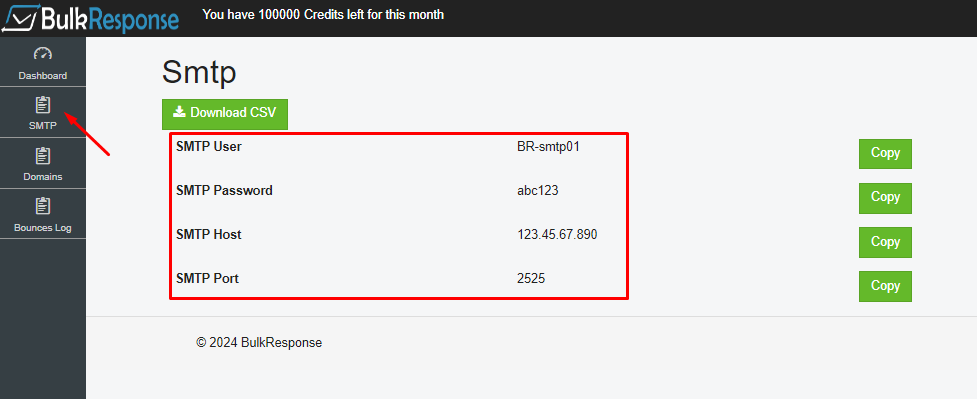
    Access SMTP Detail: Login to your Bulkresponse account and access your SMTP Detail that provided by Bulkresponse, if you don’t have an account then you can sign up from here

    }

    Step 2

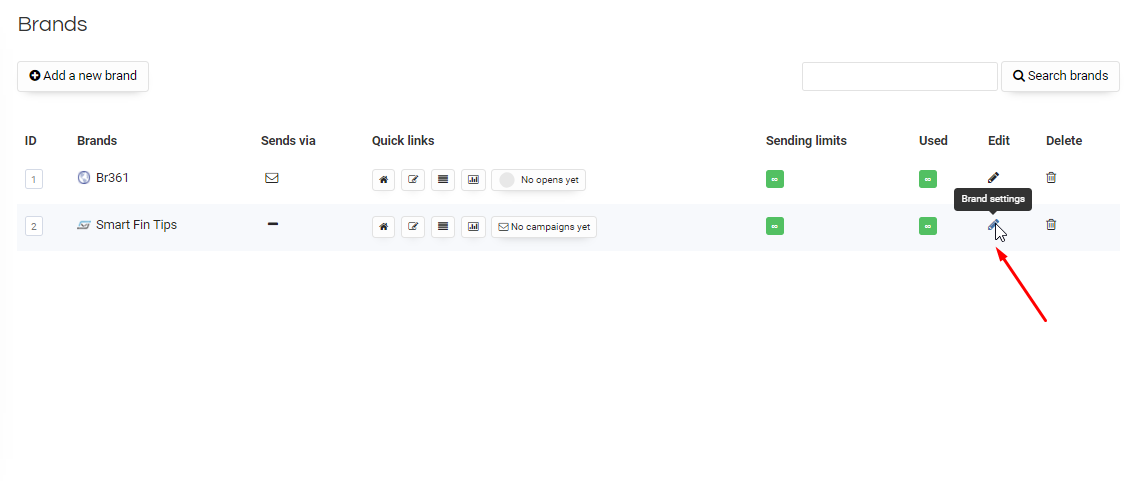
    Navigate to Settings: Once logged in, navigate to the brand settings section within the Sendy dashboard.

    Step 3

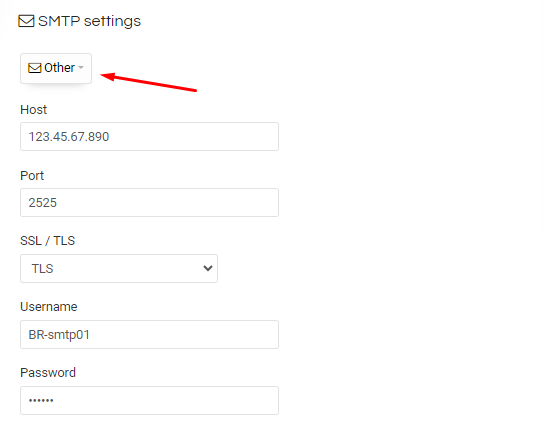
    Select “SMTP Settings”: Locate the “SMTP Settings” option within the settings menu and select Other .

    Enter Bulkresponse SMTP Credentials: Enter the SMTP credentials provided by Bulkresponse, including the SMTP server address, port number, username, and password and save setting.

    Step 4

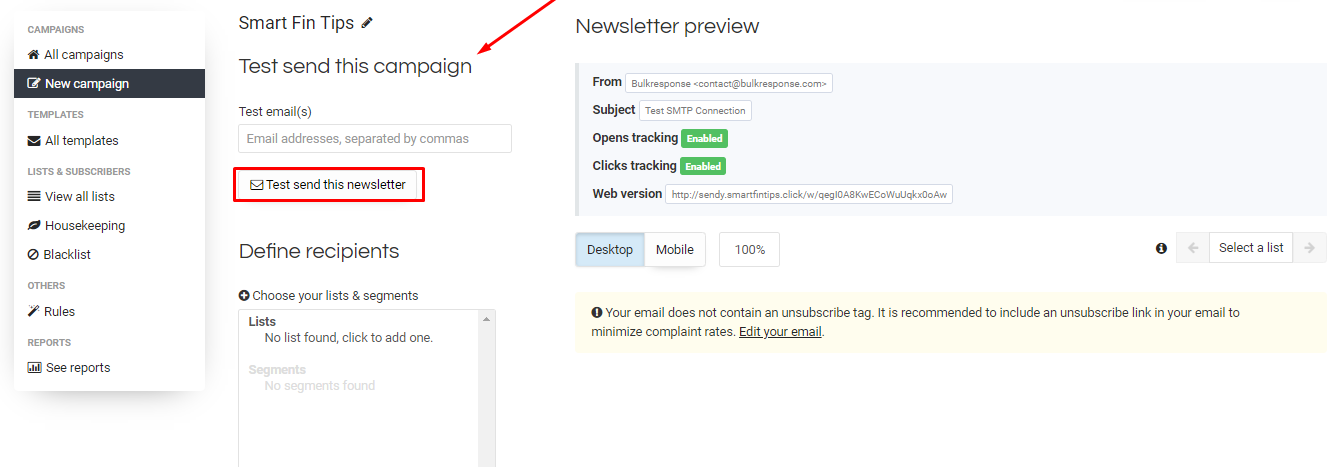
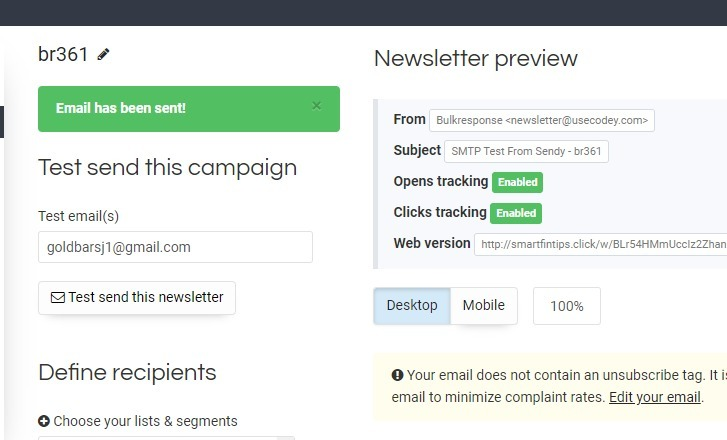
    Test Connection: After entering the SMTP credentials, Sendy provides an option to test the connection but first you have to create your campaign.  Login your brand account and locate the “Test send this campaign”  under the Campaign and then add you email address and Click on the “Test Send this Newsletter

    All Set & Done

    Conclusion : Benefits of Sendy’s Integration with BulkResponse SMTP Server

    In the end you must keep in mind the following benefits that you will reap through this amazing integration

    1. Cost-Effective Email Sending: BulkResponse SMTP server offers a reliable and affordable solution for sending emails through Sendy. This integration allows businesses to enjoy significant cost savings compared to traditional email sending services.
    2. Enhanced Deliverability: Leveraging BulkResponse’s SMTP server improves email deliverability, ensuring that your messages reach the intended recipients’ inboxes promptly.
    3. Reliable Infrastructure: The use of BulkResponse’s SMTP server adds an extra layer of reliability to your email campaigns, backed by a trusted and secure infrastructure.
    4. Real-Time Tracking and Analytics: The integration facilitates real-time tracking of email campaigns, providing valuable insights into open rates, click-through rates, and other metrics crucial for refining your marketing strategies.

    So what’s the wait? get started today with Bulkresponse and avail this amazing limited time offer of 20% off on all services, Just Enter Discount Code : OFF20

    Click Here To Avail This Amazing Discount

  • Year-End Surge: Meeting Sales Targets Through Bulk Emailing in Q4

    Year-End Surge: Meeting Sales Targets Through Bulk Emailing in Q4

    So it has been a one of the worst years of global economy and throughout the year you faced two types of prospects, the ones that don’t want to buy your product and the ones that want to buy it, but just can’t afford it. And now as this year is about to end, your boss is not happy with your progress and you are nowhere near your annual sales target. My friend now you have only two options:
    1) Come Up Good Excuses
    2) Take Advantage Of Quarter 4 To Meet Your Sales Target

    Worried Email Marketer

    Throughout the world the best sales people are not the ones that work the most hardest but they are the ones that work the most smartest. Theses best salesmen are always looking out for changing Trends, Markets, People’s sentiments and of course the changing Seasons. Did you know the biggest sales are always done during Quarter 4, especially during The Christmas and New Year’s Holidays?
    Now you will say that’s all fine but Quarter 4 is almost over and I don’t know where to start.

    best email marketing tool


    This is where BulkResponse comes in for the rescue, used and trusted by only the best bulk email marketer throughout the world, Bulkresponse comes with email marketing tools that can start generating you sales in a matter of days if not in hours. Here’s is a brief detail on how Bulkresponse email marketing tools can help you achieve your sales targets in quarter 4:

    EMAIL LIST CLEANING

    With Bulkresponse email list cleaning service we can clean your raw leads making sure that you have definite prospects to target for your email marketing campaign, our email list cleaning tool removes all the duplicate emails, dirty MX, spam traps, honey pots, serial complainers, and bad syntax by scrubbing your list against our millions of historical data records.

    SMTP Relay Service

    Next lets make sure that your bulk emails get delivered. With over 95% deliverability rate, Bulkresponse SMTP service maintains a steady email delivery rate of 95% across all major ISPs including Yahoo, AOL, Hotmail and Gmail. 

    Unlimited Bulk Emailing

    Now you don’t have that much time and you need to send bulk emails daily, So you need a service that does not impose unreasonable limits to your campaign. With Bulk Response email marketing software you get unlimited contacts per account, unlimited autoresponders, unlimited custom fields, automatic bounce handling and much more.

    Conclusion

    In beginning of this article It was said, that you have two options and one of these two we clearly explained, now its entirely your choice to make the right decision for your career as an email marketer or as a small business owner trying to make his business bloom. At last you might say you don’t have enough budget for affording such high quality service, for this we also got you covered.

    For the past 15 years Bulkresponse has not only been the best email marketing solution on the internet, but also the most affordable, in fact you are in luck as we are offering 20% special limited discount on all our services that you can avail by applying our discount code : OFF20.

    So There is no time to waste, each second you wait to make this right choice is the second you have lost a potential customer.

    Click Here To Avail This Offer Now.

  • 7 Habits of Highly Successful Email Marketers

    7 Habits of Highly Successful Email Marketers

    Nowadays, everyone believes they know what email marketing is, especially with services like BulkResponse email marketing software. However, you tend to become complacent as it takes care of everything for you. Still, not everyone knows how to utilize these great tools effectively to maximize their sales. For these reasons, we present ‘The 7 Habits of Highly Successful Email Marketers.’

    7 Habits of Highly Successful Email Marketers Video

    1) Early Adopters

    embrace new trends,

    Early adopters are the marketers who enthusiastically embrace new trends, engage promptly with innovations, and look for customer feedback. This is pivotal for testing and refining marketing strategies. Being watchful to market trends and continuous learning can significantly contribute to campaign success and brand growth.

    With Bulkresponse as your mass emailing copilot, you will have enough data and time to do all the market analysis you need to do to keep up with ever so evolving market trends

    2) They Always Test Their Emails Before Sending

    Testing Their bulk Emails Before Sending

    A wise man once said to me that the value you give to your content, is as much valuable the prospects will consider it and things you value most are presented with Quality. Highly successful email marketers thoroughly test their emails for formatting, functionality, and deliverability. They make sure the time and effort they are putting in writing are not wasted by minor overlooks.

    Take advantage of Bulkresponse’s email testing and preview tools to ensure your emails are error-free and display correctly on various devices and email clients. This reduces the risk of technical issues and ensures a seamless recipient experience.

    3) They Send Emails Regularly

    Send bulk Emails Regularly

    Consistency is key, an expert email marketers maintain a regular email schedule to keep their audience engaged. Consistency is a fundamental habit of all professional email marketers. Regular email communication keeps your audience engaged and informed. It also helps build trust and expectation among your subscribers. Whether you send weekly newsletters or monthly updates, maintaining a consistent schedule ensures that your audience remains actively connected to your brand. For example, Habitual marketers send email at least once a day, on the other hand more aggressive marketers send mails on daily bases or every other day.
    But all this is easier said than done, writing the email content it self is not the only problem but you also have to remember when to send it.

    For this utilize Bulkresponse’s mass emailing automation and scheduling features to plan and execute email campaigns consistently, ensuring a steady flow of communication.

    4) They Guard Their Reputation

    Guarding Email Reputation

    Maintaining a positive sender reputation is vital. Successful email marketers keep good care of email list hygiene and free from invalid or inactive addresses. Your cold email sender reputation significantly impacts email deliverability. Expert marketers understand the importance of email list hygiene. They regularly clean their email lists to remove invalid, outdated, or inactive email addresses. This practice reduces bounce rates and ensures that emails are sent to engaged recipients, preserving your sender reputation and enhancing deliverability.

    Use Bulkresponse’s email hygiene service to identify and remove invalid or inactive email addresses. This helps reduce bounce rates and preserve your sender reputation.

    5) They Use Eye-Catching Subject Lines

    Crafting attention-grabbing subject lines is a priority for successful email marketers. Subject lines are the first thing recipients see when they receive an email. Best email marketers invest time and creativity into crafting subject lines that capture attention and entice readers to open the email. Engaging subject lines are essential for improving open rates and encouraging interaction with your content.

    Leverage Bulkresponse’s templates to optimize your subject lines for higher open rates.

    6) They Plant at Least Two Call to Actions

    Two Call to Actions

    Effective emails have clear and compelling calls to action (CTAs). Successful email marketers understand the significance of providing multiple clear CTAs within their emails. This strategy gives recipients options to engage with your content, whether it’s making a purchase, signing up for a newsletter, or downloading a resource. Well-placed and engaging CTAs increase the likelihood of conversions and user engagement

    Bulkresponse’s email marketing software allows you to create and customize multiple CTAs in your emails, increasing the likelihood of conversions and user engagement.

    7) They Segment Their Email Data Regularly

    segmenting email data

    Successful email marketers use segmentation to tailor their messages to specific audience groups. Segmentation is the practice of categorizing your email list into distinct groups based on factors such as demographics, behavior, or preferences. Successful email marketers utilize this technique to send targeted content to different segments. By tailoring messages to specific groups, marketers can increase relevancy, engagement, and the overall effectiveness of their email campaigns.

    Utilize Bulkresponse’s robust email segmentation tools to send targeted content to different segments of your email list based on their preferences and behavior.

    Conclusion:

    By following these footsteps of the ones that made it and taking advantage of Bulkresponse’s email marketing services, you can optimize your email marketing campaigns and achieve greater success in engaging your audience. But that’s not all! We’re excited to offer an exclusive opportunity for our readers. Use the discount coupon code OFF20 to enjoy a fantastic 20% off your first subscription with Bulkresponse. It’s your chance to supercharge your email marketing efforts at an unbeatable value. Don’t miss out on this limited-time offer—start driving exceptional results with Bulkresponse today and save big!

  • The Ultimate Guide to Cold Email Outreach

    The Ultimate Guide to Cold Email Outreach

    Cold Email Outreach

     Introduction

    Cold email outreach is an inexpensive marketing strategy where you send an email to a potential customer who doesn’t know you or your business. It’s also referred to as �inbound,� �infusion,� and �prospecting.� The idea behind cold email outreach is to get potential customers’ attention by establishing yourself as a valuable resource. If a potential customer is interested in your product or service, they’ll reply back to you. If they’re not interested, they’ll ignore you. One of the best ways to overcome the fear of reaching out is to think like an entrepreneur. Remember that cold email outreach is not spam � it’s good old fashioned marketing (or, in this case, self-marketing).

  • 5 Cheap and Affordable SMTP Relay Services in 2023

    5 Cheap and Affordable SMTP Relay Services in 2023

    Introduction

    In this article you are going to learn about 5 cheapest and little known SMTP relay services you can choose from that will not break your bank account.

    Email is the most used channel of communication on internet — an incredible 306.4 billion messages are sent and received consistently on daily basis. Email Marketing is one of the most well-known specialized business strategies for organizations and people. Have you halted and considered what happens after you click “send”? How does your email message go from you to your recipients? There’s a complicated cycle happening in the background to receive your messages where they should be. At a point, all things considered, is an email convention known as SMTP that is basic for sending messages… and in this article you’re going to learn all about STMP replay services.

  • 5 Things You Should Know Before Choosing Bulk Email Service

    5 Things You Should Know Before Choosing Bulk Email Service

    Most marketers feel hesitation while sending out the bulk emails. Is everything in the email up to the mark? Do all the links work? It’s enough to make the most experienced marketers break a sweat due to fear and agitation problem.

  • 6 Reasons Why You Need an Email List Clean Service

    6 Reasons Why You Need an Email List Clean Service

    If you are doing Bulk Email marketing to target a list, then List Clean Services are absolutely must for you. Not only will it increase your Open and Click rates but List Cleaning will save you lot of headaches like getting blacklisted, affecting email and sales continuity, and much more.

  • GENERAL GUIDELINES FOR SENDING THE MASS EMAIL

    GENERAL GUIDELINES FOR SENDING THE MASS EMAIL

    Let’s say, you want to send a mass email to your subscribers, without sounding spam. Also, you want your bulk email marketing campaign to be effective as well. If you want to get it out quickly as you don’t have time to read a hundred guides about email marketing, then these are some of the general tips for providing a good mass email service in the first place.

  • 5 Emails to Send to Your Customers and How to Send Them

    5 Emails to Send to Your Customers and How to Send Them

    So you have been down the road and already have taken the first step toward by building your contact list, and now you need to send something to your subscribers. But what should that something be? And how that something needs to be delivered?

  • MOST COMMON MISTAKES IN E-MAIL MARKETING

    MOST COMMON MISTAKES IN E-MAIL MARKETING

    No one expects to hear that e-mail is dead. In many ways, e-mail is dead for a lot of small reasons that people might not consider in start but those mistakes leave a long lasting effect. If your e-mail list is not growing, your unsubscribe rates are more than your open rates, you may want to rethink how to use e-mail more effectively to reach your target audience.

  • Things You Need To Know About BulkResponse

    Things You Need To Know About BulkResponse

    I have been thinking hard on what we should write about the first blog post on our official blog. Then we had huge brainstorming session in house (yes, it is that hard) and we all agreed, why not start answering some common questions customers ask us every day.